
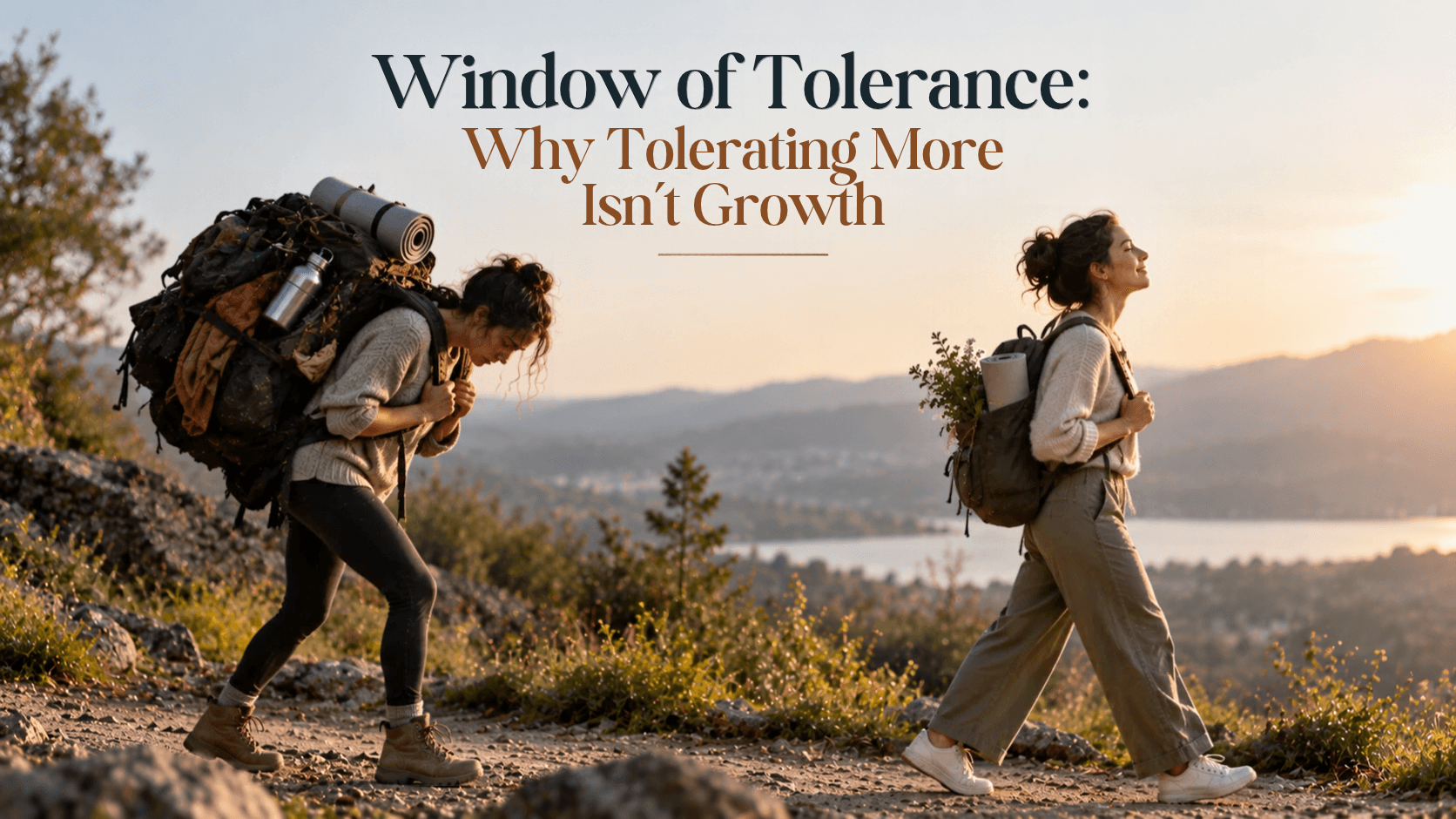
Why More Tolerance Is Not the Same as Expansion
Being able to endure more is not the same as having more capacity. You can become exceptionally good at tolerating conditions that simultaneously reduce your access to yourself, your relationships, your recovery and your wider life. The useful question is not how much activation you can withstand, but what remains available to you while you withstand it.
The Assumption Worth Questioning
A powerful assumption runs through much contemporary language about resilience, nervous system regulation and personal development: progress means becoming able to tolerate more.
You can remain in difficult situations for longer, experience stronger activation without withdrawing, work under greater pressure, and continue functioning across increasingly complex demands.
At first glance, this appears consistent with growth.
Yet the equation is conceptually unstable, because human beings can become exceptionally good at enduring conditions that simultaneously reduce their access to themselves, relationships, recovery and meaningful life.
Tolerance and Expansion Answer Different Questions
Human Expansion Theory therefore distinguishes tolerance from Expansion, because the two are not measuring the same thing.
Tolerance concerns how much activation or challenge can be sustained before functioning becomes compromised.
Expansion concerns whether you can move toward meaningful possibility while preserving enough flexibility, self-access, relational connection, recovery and choice to remain genuinely present within the experience.
Why This Matters Most for High-Functioning People
This distinction is especially important in highly functional people, because external output can remain stable while internal cost rises.
Research on cognitive effort demonstrates that effort carries subjective and motivational costs even when performance is maintained (Shenhav et al., 2017). Stress research likewise shows that cognitive functions such as working memory and flexibility can be affected under acute stress, although effects vary across tasks and individuals (Shields et al., 2016).
Human Expansion Theory draws on this broader scientific context while introducing its own theoretical construct of Functional Overdrive, in which performance remains intact while compensatory effort progressively increases.
Why Endurance Can't Prove Capacity Has Grown
Functional Overdrive illustrates why endurance alone cannot establish that capacity has expanded.
You may work longer hours, tolerate more conflict, make more decisions, and remain outwardly composed while requiring increasing amounts of preparation, control, suppression, checking or recovery.
The system is not necessarily becoming more capable in a developmental sense. It may simply be spending more resource to preserve the same level of functioning.
Resilience Is Not Toughness
Contemporary resilience science supports the need for this distinction, because resilience is not reducible to toughness.
Modern models increasingly conceptualise resilience as dynamic, context-dependent adaptation rather than simple resistance to stress (Bergeman & Nelson, 2024; Hermans et al., 2025).
Psychological flexibility research makes a similar point. Kashdan and Rottenberg (2010) argue that healthy functioning involves adapting behaviour to situational demands, maintaining balance across domains, and pursuing values without rigidly applying one strategy.
Flexible adaptation is therefore fundamentally different from rigid endurance.
The Paradox
This produces an important paradox.
Someone who can remain in an unsustainable situation indefinitely may demonstrate high tolerance but low flexibility.
Someone else who recognises that the situation no longer fits, changes direction, and tolerates the uncertainty created by that change may demonstrate greater developmental capacity.
Human Expansion Theory therefore proposes that Expansion should not be measured by the maximum amount of stress you can withstand. It should be understood in relation to the range and quality of participation that remain available without disproportionate loss of self.
Two Executives, Same Complexity
Consider two executives facing similar levels of organisational complexity.
One maintains performance by working continuously, reducing recovery, limiting delegation, and becoming increasingly intolerant of interruption.
The other remains effective while redistributing responsibility, preserving recovery, using support, and eliminating unnecessary demand.
The first may appear more tolerant. The second may possess greater capacity, because less of the person is being consumed by the work required to remain functional.
The Same Distinction in Relationships
Someone who learns to tolerate repeated boundary violations has not necessarily expanded.
Someone who becomes able to identify a boundary earlier, communicate it, tolerate another person's disappointment, and remain connected to themselves may have.
The developmental achievement is not the capacity to endure more mistreatment. It is greater flexibility, access and choice.
Where the Window of Tolerance Gets Misread
This is why simple interpretations of the "window of tolerance" can become misleading when translated into the idea that development means tolerating more activation.
You can remain apparently functional during intense activation through suppression, rigid control, dissociation or compulsive effort.
Human Expansion Theory therefore asks a different question: what remains available while activation is present?
If cognition becomes rigid, if relational information disappears, if you lose access to preference and limits, if recovery becomes increasingly difficult, or if the rest of life is progressively compressed around the challenge then greater tolerance may not represent greater expansion.
By contrast, if the same level of challenge can be encountered with more flexibility, better recovery, greater self-access and less protective expenditure, the developmental picture is entirely different.
Why Doing Less Can Be Growth
This distinction also explains why doing less can sometimes represent growth.
If development is defined solely as tolerating more, reducing demand appears regressive. Yet if development is defined in terms of available life, reducing unnecessary load may release resources for more meaningful participation.
Someone who relinquishes several low-value responsibilities may become capable of entering one high-value challenge that previously felt impossible.
Externally, they are carrying less.
Developmentally, their life may be becoming larger.
Why Cultures Reward the Wrong Thing
This correction is particularly important in cultures that reward endurance.
Workplaces often interpret the ability to absorb excessive demand as strength. Families may reward the person who carries everyone. People who have survived adversity may themselves equate the ability to withstand distress with recovery.
Yet endurance can reproduce protection. You can survive by becoming more rigid. You can stay productive by disconnecting. You can continue functioning by narrowing life around what must be achieved.
Contemporary resilience work increasingly emphasises adaptive flexibility rather than endless endurance, which supports the need to distinguish resilience from simple stress tolerance (Bergeman & Nelson, 2024; Hermans et al., 2025).
The Question That Replaces "How Much Can You Take?"
Human Expansion Theory therefore asks: does greater challenge leave more or less of the person available?
This question introduces resource cost into the definition of growth.
A challenge may remain objectively demanding but become less internally expensive through learning, skill, support, reduced threat expectation, familiarity and improved recovery. Expansion has then occurred — not because you have learned to suffer more, but because participation consumes less protective resource.
This creates a direct link between Capacity and Expansion. Capacity can increase because the same demand becomes less resource-intensive. Expansion can then use the freed resource for broader participation.
The opposite can also occur. You may tolerate greater external demand while internal cost escalates faster than available resource. You look increasingly capable precisely as less of you remains available elsewhere.
What Strength Actually Includes
This is why output alone cannot establish development.
Nor can discomfort alone.
A meaningful developmental assessment must examine demand, resource, flexibility, recovery, access, relationship, and the cost of participation.
Expansion does not ask you to become invulnerable. It asks whether you can engage with more life without progressively disappearing in order to do it.
That distinction changes the meaning of strength. Strength is not merely the ability to carry more. It includes knowing what should not be carried, what can be shared, what is worth the effort, and what becomes possible when unnecessary expenditure stops.
More tolerance can be useful.
But tolerance is not the destination.
Expansion is.
Where This Work Is Applied
Within the Life Beyond Trauma Method, this distinction prevents recovery from becoming a project of learning to endure increasingly difficult circumstances. Capacity-building is directed toward fuller participation rather than greater suffering tolerance.
Within the Regulation Suite, regulation tools support flexibility and recovery rather than being used to force continued functioning under excessive demand.
Within Executive Advisory, this distinction is fundamental. Greater leadership capacity does not mean teaching executives to absorb endlessly increasing pressure. The Capacity Recalibration Model examines how demand can be redistributed, reorganised, or made less resource-expensive while leadership scope expands.
Frequently Asked Questions
Is increasing stress tolerance useful?
It can be. The ability to remain present during manageable activation is valuable. The problem arises when tolerance becomes the only measure of progress.
Is resilience the same as tolerating more?
No. Contemporary resilience science conceptualises resilience as dynamic adaptation rather than simple toughness or endurance.
Can doing less represent growth?
Yes. Reducing unnecessary load can free resources for more meaningful participation.
How do I know whether I am expanding or merely enduring?
A useful question is what remains available while you meet the demand: flexibility, recovery, choice, relational access, self-awareness, and capacity for the rest of life.
Does expanding your window of tolerance mean you are growing?
Not necessarily. You can appear functional during intense activation through suppression, rigid control or compulsive effort. What matters is how much flexibility, self-access and recovery remain available while the activation is present.
Why do I feel capable and exhausted at the same time?
Performance can be maintained while the effort required to maintain it keeps rising. Output stays stable; the internal cost does not. That combination is common and is not evidence that capacity has increased.
About the Author
Caroline Reed, MA, MBACP is a psychotherapist and trauma specialist with more than 25 years of professional experience and founder of The Nervous System Institute. Her work focuses on the relationship between nervous system function, protection, human capacity, and participation in life. She is the developer of Human Expansion Theory, an emerging theoretical framework exploring the developmental conditions of Safety, Capacity, Availability, Expansion, and Participation.